Teacher Growth & Career Advancement
India's Education Portals Are Growing Up and the Shift Is Bigger Than It Looks
AUTHOR: Bewise-Admin


For most of the last decade, online education in India had one goal: reach more students.
The logic was straightforward. A country with over 250 million school-going children, a shortage of qualified teachers, and extreme geographic inequality had an obvious problem. Scale was the solution. More videos, more courses, more users. And it worked up to a point.
Platforms grew rapidly. Content libraries expanded. Students in tier-2 and tier-3 cities got access to lectures they could never have found locally. By 2022, India had become the second-largest edtech market in the world.
But underneath the growth numbers, a quieter problem was building.
Completion did not equal learning. Students were watching lectures and passing assessments without retaining much. The medium had changed. The outcome, in many cases, had not.
That is now changing, and the shift is more substantive than the usual edtech hype cycle suggests.
What Went Wrong with the First Generation of Edtech
The original model was essentially a digitized textbook. Lectures were recorded and uploaded. Students watched them. Tests were administered. Certificates were issued.
The problem was structural. Passive consumption, like watching a video, produces very different cognitive outcomes than active engagement. Without interaction, feedback, or adaptation to individual learning gaps, many students fell behind in silence. They could not raise their hands. No one noticed.

Research from MDPI's review of Indian edtech interventions found that outcomes varied significantly based on design: technology-driven models that included interaction, feedback, and teacher involvement improved learning; those that functioned purely as content repositories showed little measurable effect.
The takeaway is not that edtech failed. It is that the design of the platform matters as much as the content on it.
Three Genuine Shifts Happening Now
1. Adaptive Learning Is Moving From Concept to Practice
The first generation of personalization in edtech was superficial. Recommending the next video based on what you watched last. Today's systems are attempting something more meaningful.
AI-driven platforms are now mapping individual learning gaps in real time, adjusting question difficulty, identifying concepts where a student consistently stumbles, and routing them to targeted remediation before moving forward. EY's research on AI in education describes this as enabling genuinely personalized learning trajectories - a meaningful departure from the one-size-fits-all lecture format.

The practical implication: a student who has understood algebra, but not quadratic equations is no longer moved through the curriculum at the same pace as one who has mastered both. The platform catches the gap. The student gets what they actually need.
This is still developing. The quality of adaptive systems varies widely, and the data needed to make them work well takes time to accumulate. But the directional shift is real.
2. AI Is Partially Addressing India's Teacher Shortage
India faces a shortage of approximately one million trained teachers, concentrated most acutely in rural and semi-urban areas. In many government schools, a single teacher manages multiple grades simultaneously. Individual attention is structurally impossible.
This is where AI tutoring tools are making a measurable difference. Not by replacing teachers, but by providing what a stretched teacher cannot - immediate, personalized responses to individual student questions.
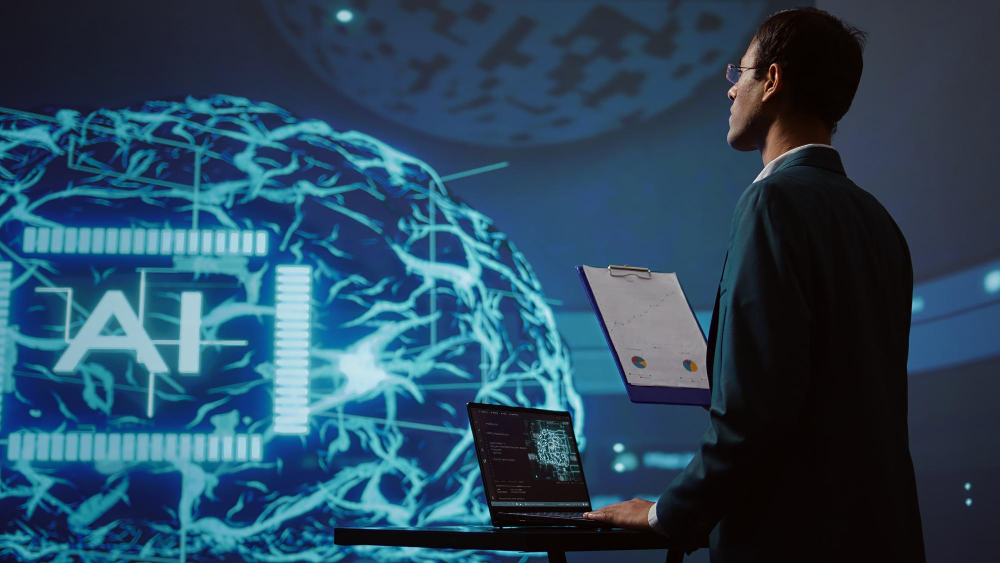
SATHEE, a government-backed AI tutoring platform launched to support JEE and NEET aspirants, illustrates the model. It provides AI-driven doubt resolution, adaptive mock tests, and career guidance at no cost, reaching students who cannot afford private coaching. The platform processed millions of student queries within its first year of operation, offering real-time guidance at a scale no human faculty could match.
The important caveat: AI tutoring works best as a supplement, not a substitute. Students who have access to good teachers and also use AI tools tend to outperform those relying on AI alone.
3. The Teacher's Role Is Genuinely Changing
There is a common anxiety that AI will displace teachers. However, the evidence points in a different direction. It is changing what teachers spend their time on in ways that arguably improve both teacher satisfaction and student outcomes.
Administrative tasks such as grading routine assessments, tracking attendance, and generating performance reports can be largely automated. When that happens, the time recovered can go toward the work that machines cannot do – questioning students to test understanding, identifying the student who is lost but too shy to ask, building the kind of classroom relationship that motivates a teenager to keep trying.

EY's analysis of AI in educational settings found that reducing administrative workload allowed teachers to direct more time toward mentorship and complex instruction. That reallocation matters. Teaching is fundamentally a human activity, and AI works best when it handles the repetitive margins so that humans can focus on the core.
What Outcome-Based Education Actually Requires
Shifting from content delivery to genuine learning outcomes requires more than better technology. It requires rethinking what platforms measure and what they are accountable for.
The current standard of course completion rate is nearly meaningless as a proxy for learning. A student can complete 100% of a course and retain almost nothing if the design does not require active engagement, spaced repetition, or application.
Platforms genuinely committed to outcomes are moving toward measuring concept mastery over time, performance on application-based assessments rather than recall questions, and skill demonstration rather than certificate acquisition.
Some are beginning to offer outcome guarantees like linking fees or refunds to job placement or skill assessment results. This is an imperfect model with its own complications, but it represents a meaningful accountability shift.
Where the Gaps Remain
It would be misleading to present this as a solved problem.
Access inequality persists. Students who would benefit most from adaptive AI tools are those in rural areas, government schools, or low-income households. But they have the most unreliable internet access and the least capable devices. Sophisticated edtech tools are currently most accessible to students who already have the most resources.
Teacher readiness is uneven. The shift toward hybrid and AI-assisted classrooms requires educators who are comfortable with technology and trained in new pedagogical approaches. Teacher training infrastructure in India has not yet caught up with the pace of platform change.
And the AI itself is imperfect. Adaptive learning systems are only as good as the data they are trained on. Early in a student's engagement with a platform, personalization often is limited. It improves over time, which creates a paradox. The students who engage most get the most personalized experience, while those who struggle to engage and may need it most, get the least.
The Real Question Going Forward
India's edtech sector has answered the access question reasonably well. Affordable data, smartphones, and a generation of content platforms have ensured that a student in rural Bihar can watch a lecture by a teacher in Delhi.
The harder question is next: did that student actually learn?
Answering it requires better measurement, more accountable platform design, and a clearer-eyed assessment of what technology can and cannot do. The platforms that take that question seriously and build toward answering it with data will define the next decade of Indian education.
Those that do not, will become very large content libraries. Content is no longer the problem. Learning is.
Sources: Ministry of Education — National Education Policy 2020
EY Report on AI in Education
MDPI Review of Edtech Interventions in India
Times of India — SATHEE Platform Coverage
IBEF Indian Edtech Market Report
Frequently Asked Questions
1. Why did first-generation edtech platforms fall short on learning outcomes?
Most early platforms were designed around content delivery recording and distributing lectures at scale. Without built-in feedback loops, personalization, or active engagement mechanisms, students could complete courses without retaining much. Design, not technology, was the limiting factor.
2. What does "adaptive learning" actually mean in practice?
Adaptive learning means the platform adjusts what it shows a student based on their actual performance, not just what they watched, but what they understood. If a student consistently gets a type of problem wrong, an adaptive system routes them to targeted practice before advancing. The quality of this varies significantly across platforms.
3. Is AI replacing teachers in Indian classrooms?
No, and the framing is misleading. AI tools are handling administrative tasks and providing on-demand doubt resolution, which frees teachers to focus on instruction, mentorship, and individual attention. The evidence suggests that the best outcomes come from combining AI tools with effective teachers, not replacing one with the other.
4. What should students and parents look for in an online education platform today?
Look for platforms that measure concept mastery rather than just completion, include interactive and application-based assessments, offer mechanisms for doubt resolution, and are transparent about learning outcomes not just course libraries or certificate counts.
5. What is SATHEE and who is it for?
SATHEE is a government-backed AI tutoring platform designed to support students preparing for competitive exams like JEE and NEET. It provides AI-driven doubt solving, adaptive mock tests, and career guidance at no cost, with the goal of making high-quality exam preparation accessible beyond private coaching centers.